One Safety Vision: The Great Knowledge Exchange
Amidst the growing convergence of safety-critical sectors to support tomorrow’s integrated energy system, OPITO commissioned research to understand what gives Asia Pacific’s safety-critical industries the confidence to share safety knowledge and skills.
Bridging the 'Confidence Gap' in Skills and Competencies Across Asia-Pacific's Safety-Critical Industries
As safety-critical industries across Asia Pacific become increasingly interconnected, the opportunity to share knowledge, skills and experience across sectors has never been greater. With energy, mining, renewables and other safety-critical industries collaborating to support the integrated energy systems of tomorrow, workers are increasingly operating beyond traditional sector boundaries.
Many of these industries already share common safety principles, competencies and operational challenges. Yet while the foundations for greater workforce mobility are in place, confidence can weaken when skills, qualifications and experience need to be recognised across sectors, employers, projects or geographies. The challenge is not simply whether skills exist, but also whether they can be understood, trusted and transferred beyond traditional boundaries.
To better understand what gives employers and workers confidence in workforce competence, OPITO commissioned research exploring the factors shaping trust, mobility and skills transferability across Asia Pacific's safety-critical industries. Based on a survey of 390 employers, operators and workers across six markets and five sectors, the research provides insights into the opportunities and barriers influencing workforce mobility across the region.
Why This Research Matters
Across Asia Pacific, safety-critical industries are facing growing demand for skilled people while becoming increasingly connected through shared projects, technologies and supply chains. As organisations look beyond traditional sector boundaries to source talent and expertise, confidence in workforce competence becomes increasingly important.
The findings reveal both a strong foundation of workforce competence and a growing appetite for greater workforce mobility. However, they also highlight practical challenges when training, certification and experience are not consistently recognised or easily verified across sectors. Understanding how to build trust in transferable skills is critical to enabling knowledge exchange, supporting workforce resilience and creating a more flexible, multi-skilled workforce capable of meeting future industry needs.
Key Findings
Strong Foundations for Skills Mobility
76% of employers are confident workers and contractors have the right training, skills and behaviours to work safely in hazardous environments.
Recognition Drives Trust
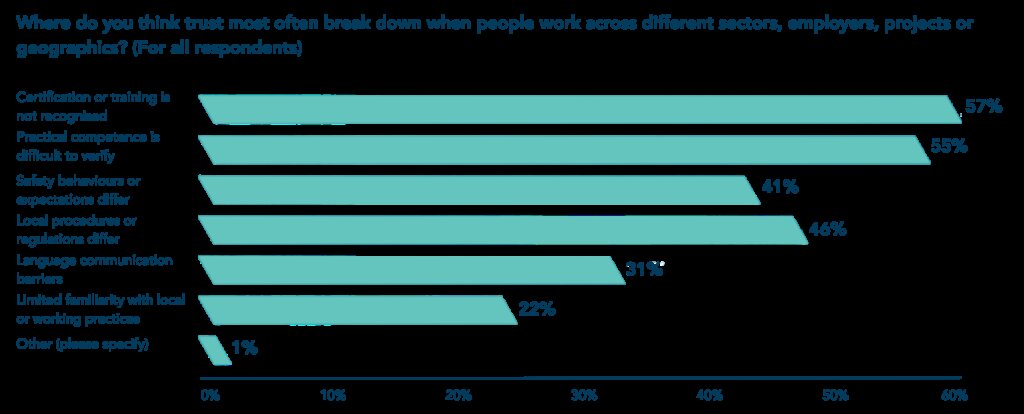
57% of respondents say trust breaks down when training or certification is not recognised across sectors, employers, projects or geographies.
Verifiable Competence Builds Confidence
55% of respondents say trust breaks down when practical competence is difficult to verify.
Shared Standards Enable Mobility
61% of respondents say globally aligned training and safety standards would do most to build trust in a workforce system where people can move more easily between sectors, employers, projects and geographies.
Valued Experience Encourages Movement
60% of workers who are open to or neutral about moving into an adjacent safety-critical sector say evidence that their experience would be valued would give them the greatest confidence to make the move.
Towards a Shared Language of Safety
The research highlights a significant opportunity for industry, governments, training providers, regulators and standards bodies to work together to improve how competence is recognised and understood across sectors. By creating stronger alignment between training, qualifications, certification and competence assurance, safety-critical industries can help remove unnecessary barriers to workforce mobility, encourage knowledge sharing and support the development of a more flexible, multi-skilled workforce.
The report identifies greater interoperability of standards and clearer recognition of existing competence as potential pathways to building trust, enabling workers to transfer valuable skills and experience between industries while maintaining the highest standards of safety and operational performance.
Explore the full report to discover the latest insights into workforce confidence, skills transferability and the future of workforce development across Asia Pacific's safety-critical industries. The report includes detailed findings, country-level analysis and areas for industry consideration for creating trusted pathways that enable skills and knowledge to move more freely across sectors.
This research forms part of OPITO's wider commitment to working alongside industry to build safe, skilled and future-ready workforces capable of meeting the needs of an increasingly connected energy and industrial landscape.